
By Elume Raymond

The African Cup of Nations (AFCON) is one of the most popular and most-watched events across the entire sports calendar.
Taking place every two years, the AFCON pits the best football nations in Africa against one another to crown a champion of the sport.
While most players play for their club teams throughout much of the season, international football is also a major draw in the sport. Players who hail from the same nation all come together to compete for their country, with national pride at stake.
The AFCON, therefore, is the preeminent international football tournament in Africa, which features the best players around the continent. Major powers like Egypt, Cameroon, Ghana, Nigeria, Algeria and DR Congo will all take part, as will defending champions, Cote d’Ivoire.
This platform brings you all the basics to help casual fans enjoy one of the most popular sporting events the modern world has to offer. Our expert analysis and previews on all games will be made available on this platform to guide you on how to get the best statistics and information on every single detail available on AFCON 2025 in Morocco.
How does the AFCON work?
The AFCON is played every two years to crown the best football nation across the continent.
The 2025 Africa Cup of Nations qualification matches were organised by the Confederation of African Football (CAF) to decide the participating teams of the 2025 Africa Cup of Nations in Morocco, the 35th edition of the international men’s football championship of Africa. A total of 24 teams qualified to play in the final tournament, including Morocco, who qualified automatically as hosts.
All 54 CAF member associations entered the competition except Seychelles and Eritrea which were excluded by CAF. The seeding was based on the FIFA (Federation International Football Association) World Ranking from 15 February 2024 with teams ranked 1st to 44th receiving a bye to the qualifying group stage, while the teams ranked 45th to 52nd had to participate in the preliminary round.
The eight lowest-ranked teams were drawn into four ties to be played in home-and-away two-legged format. The four winners advanced to the group stage to join the 44 teams which entered directly.
The 48 national teams involved were divided into twelve groups of four each (from Group A to Group L), which consisted of the 44 teams which entered directly, in addition to the four winners of the preliminary round. The 48 national teams had previously been seeded into four pots of twelve each based on the June 2024 FIFA World Rankings.
The top two teams from each group qualified for the final tournament in Morocco. The 2025 Africa Cup of Nations hosts, Morocco, participated in the qualifiers despite the team being guaranteed a spot in the finals, which meant only the best ranked team within their group apart from Morocco qualified for the finals. The Morocco matches and results counted in determining the qualification of the other teams from their group.
There were 331 goals scored in 151 matches, for an average of 2.19 goals per match.
Then, 24 qualified teams converge at the AFCON to play in a tournament to determine the continental champion:
- Morocco (hosts)
- Comoros
- Egypt
- Nigeria
- Algeria
- Angola
- Zambia
- DR Congo
- Mali
- Cameroon
- South Africa
- Senegal
- Tunisia
- Gabon
- Botswana
- Benin
- Equatorial Guinea
- Sudan
- Cote d’Ivoire
- Tanzania
- Mozambique
- Zimbabwe
- Uganda
- Burkina Faso
What does CAF stand for?
CAF is the continental football governing body that organizes all professional football competitions in Africa. They are the organizers of the AFCON.
The acronym stands for « Confederation of African Football, » and the organization’s headquarters are in Giza, Egypt.
Currently, CAF consists of 54 member nations from across the continent. The current president of CAF is Patrice Motsepe, who was elected to the position on 12 March 2025.
How many teams are at the Nations Cup?
While all 54 teams are eligible to reach the AFCON, they must all first progress through continental qualifying to identify which teams reach the AFCON tournament.
For the 2025 African Cup of Nations, there are 24 teams who have qualified for the final tournament in Morocco. They are broken up into six different groups of four teams each, with the top two in each group advancing to the knockout stage along with four best-placed-thirds.
This is the fourth edition where the 24-team format is being used.
The 24 qualified nations have been drawn into six groups of four:
- Group A: Morocco, Mali, Zambia, Comoros
- Group B: Egypt, South Africa, Angola, Zimbabwe
- Group C: Nigeria, Tunisia, Uganda, Tanzania
- Group D: Senegal, DR Congo, Benin, Botswana
- Group E: Algeria, Burkina Faso, Equatorial Guinea, Sudan
- Group F: Ivory Coast, Cameroon, Gabon, Mozambique
How are the players picked?
Each national team’s head coach selects 28 players at most to take part in the AFCON.
The rosters had been restricted to 23 players for the last several African Cup of Nations tournaments, but that was expanded to 28 for 2021 after many coaches supported the increase due to the COVID-19 pandemic.
One of the biggest jobs facing national team coaches is to select the players who will take part in the AFCON. They monitor all players eligible to play for their country, and use past performances combined with current club form to pick the 28 players they believe give them the best chance of success.
Players are eligible to play for any nation they hold a passport for and have « a clear connection » to based on either familial lineage or years spent in a country. For players who hold dual citizenship, they may choose which country to represent. They also may change allegiances once, via what is known as a « one time switch, » but once a player has either earned three competitive appearances for a national team before reaching 21 years old, or one appearance after reaching 21 years of age, they may no longer switch nations.
When and where is the tournament?
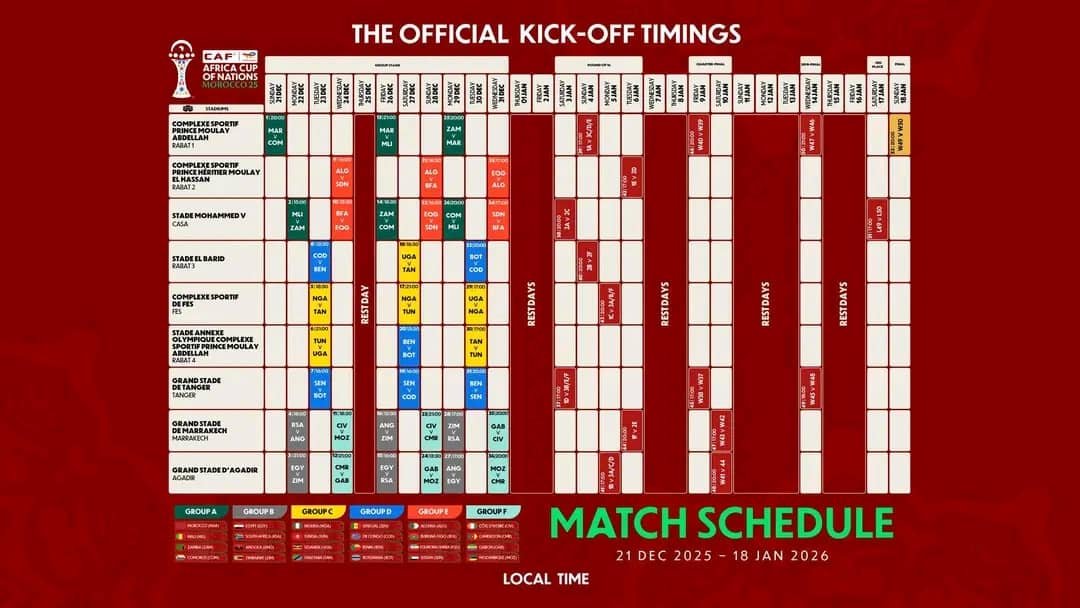
The Africa Cup of Nations gets underway on December 21, with the final scheduled for January 18. Over the course of four weeks, 52 matches will be played across nine stadiums.
Morocco widely regarded as one of the tournament favorites will open the competition with a Group A clash against Comoros.
Matches will be staged across six host cities and nine stadiums in Morocco. The tournament’s showpiece venue is Prince Moulay Abdellah Stadium in Rabat, which will host both the opening match and the final, as well as several other fixtures.
The full list of stadiums is as follows:
- Adrar Stadium, Agadir (45,480)
- Mohammed V Stadium, Casablanca (45,000)
- Fez Stadium, Fez (45,000)
- Marrakesh Stadium, Marrakesh (45,240)
- Prince Moulay Abdellah Stadium, Rabat (68,700)
- Moulay Hassan Stadium, Rabat (22,000)
- Prince Moulay Abdellah Olympic Annex Stadium, Rabat (21,000)
- Al Barid Stadium, Rabat (18,000)
- Ibn Batouta Stadium, Tangier (75,000)
Together, these venues will provide the stage for one of the most anticipated editions of the Africa Cup of Nations.
How many games are played at the AFCON?
With 24 teams slotted across six groups of four, there are 36 group stage matches which will eliminate just eight teams and qualify sixteen for the knockout stage.
In the knockout stage, there are 16 teams, meaning that 15 games must be played to eliminate all but one and leave just one team standing as the champion. Lastly, we must not forget the third-place game that is also pencilled in just before the final is played.
In total, that means there are 52 games in total to take in at the AFCON.
What games should I watch?
There are some great games already scheduled for the group stage portion of the tournament.
The one match that stands out above the rest is in Group F between African superpowers Cote d’Ivoire and Cameroon on Sunday, 28 December 2025, with the two top-10 ranked sides pulled into the same group.
Another match that will likely be a major talking point is that between Nigeria and Tunisia, which is scheduled for December 27th. With the two nations holding a playful rivalry plus some past AFCON history, it is already one of the tournament’s most highly anticipated matchups.
In the knockout stage, it’s hard to know which teams will match up, as the participating teams must qualify via their group stage finish. The latter stages of the tournament almost always feature games which pit giants against each other.
The AFCON final, one of the most-watched sporting events around the globe, is scheduled for Sunday, 18 January 2026 and will take place at 8 p.m GMT
How do I watch the AFCON?
The 2025 AFCON will be televised in Cameroon by national broadcaster CRTV. The tournament which kicks off 21 December 2025 will also be broadcast in Subsaharan Africa by CANAL+, StarTimes and SuperSport.
In the UK and Ireland, all matches will be live across Channel 4’s network, airing on Channel 4, E4, 4Seven, Streaming and Channel 4 Sport YouTube.
In the U.S., you can catch the coverage on beIN Sports and FuboTV.
Who are the players to look out for?
As ever, AFCON will showcase some of the finest talent in world football — and a few of its biggest storylines.
Mohamed Salah is the tournament’s standout name. Egypt’s talisman remains one of the game’s most decisive forwards, and this edition carries added intrigue with his future at Liverpool under intense scrutiny. Every touch, goal and gesture will be watched closely.
For the hosts, Achraf Hakimi is central to Morocco’s ambitions. The captain and one of the world’s elite right-backs, Hakimi was a vital figure in Paris Saint-Germain’s Champions League success last season and embodies Morocco’s blend of experience and tactical intelligence.
Nigeria arrive with formidable attacking firepower. Victor Osimhen, now leading the line at Galatasaray, is among the most feared strikers in international football, while Ademola Lookman continues to shine after his exploits with Atalanta. Together, they give the Super Eagles genuine title credentials.
Cameroon will look to Bryan Mbeumo for inspiration. The forward has impressed since his summer move to Manchester United and will be expected to carry much of the attacking burden for the Indomitable Lions.
Alongside the established stars, AFCON remains a launchpad for emerging talent. This tournament should offer a glimpse of the future, with young players such as Eliesse Ben Seghir (Morocco), Ibrahim Maza (Algeria), Lamine Camara (Senegal), Etta Eyong (Cameroon) and Oumar Diakité (Ivory Coast) all poised to make their mark on the continental stage.
Who are the favourites to win the AFCON?
As ever, predicting an AFCON winner is a hazardous exercise — unpredictability is part of the tournament’s DNA but several nations arrive in Morocco with credible title ambitions.
Egypt are perennial contenders, and much of their narrative still revolves around Mohamed Salah. Now approaching the latter stages of his international career he turns 34 in June Salah has already led Egypt to World Cup qualification twice, including for 2026. Yet the Africa Cup of Nations remains the missing piece. Lifting the trophy would not only end Egypt’s long wait but also cement Salah’s legacy as one of the greatest African footballers of all time.
Defending champions Ivory Coast arrive with questions hanging over them. Nearly two years on, their dramatic triumph at the last AFCON still feels improbable. History is not kind to title holders: Egypt in 2010 were the last champions even to reach the quarter-finals, while Ivory Coast themselves exited at the group stage in 2017. Since then, defending the crown has proven brutally difficult.
Nigeria once again boast one of the deepest and most talented squads in the competition. The Super Eagles are stacked with elite-level performers, including 2024 African Footballer of the Year Ademola Lookman, alongside Victor Osimhen, Alex Iwobi and Calvin Bassey. Many of the players who suffered final heartbreak against Ivory Coast last year return with unfinished business. Aside from a painful World Cup play-off defeat, Eric Chelle’s record since taking charge in January has been impressive. The question is whether Nigeria can harness their talent, manage the drama and claim their first AFCON title since 2013.
For the hosts, Morocco will carry both expectation and belief. Their historic run to the semi-finals of the 2022 World Cup the first by an African nation showcased a squad perfectly balanced between youth and experience under coach Walid Regragui. They were widely tipped to lift the AFCON trophy last year, going unbeaten in the group stage and conceding just once, only to be stunned by South Africa in the round of 16. On home soil, with passionate support behind them, anything less than a deep run would be considered a disappointment.
Cameroon, meanwhile, arrive amid turbulence. Just weeks before the tournament, the country’s football federation, Fecafoot, announced the dismissal of head coach Marc Brys, replacing him with David Pagou. Several senior figures have also been left out of the squad, including captain Vincent Aboubakar, André Onana, André-Frank Zambo Anguissa and Eric-Maxim Choupo-Moting. With little time to settle, Pagou faces a daunting task particularly in a challenging group that includes holders Ivory Coast. Yet Cameroon’s AFCON history thrives on chaos, and memories of their famous 1988 triumph in Morocco still linger.
Beyond the traditional heavyweights, South Africa and DR Congo may be the most quietly consistent sides on the continent. Both reached the semi-finals of the previous AFCON, while South Africa topped their World Cup qualifying group. DR Congo finished second behind Senegal before eliminating Cameroon and Nigeria in successive African play-off ties, earning a place in FIFA’s inter-confederation play-offs this March. They may lack the superstar names of other contenders, but both sides are tactically disciplined, well-coached and capable of springing surprises in Morocco.
At AFCON, pedigree matters but form, momentum and belief often matter more.
Elume Raymond (Twitter/X: @elumeraymond) is a seasoned sportswriter with more than a decade of experience in the field. He leverages data and analytics to deliver in-depth analysis across a wide range of sports events and topics, from regional competitions to global tournaments. Passionate about sports, Elume Raymond is dedicated to sharing his enthusiasm with his audience, offering captivating stories and unique perspectives that engage and inspire.